
Storytelling: No Campfire Required

November 3, 2009 · 12 comments

Ghana

Storytelling is powerful. Storytelling, both positive and negative, is one of the most powerful of all human capabilities. It’s a powerful tool to inspire and motivate people. I am in the job of inspiring and motivating. Anyone who has seen me on Twitter knows this to be true.

When you want to influence others, there is no tool more powerful than story. – Annette Simmons

In the age of google, spreadsheet, databases, research and technology that changes at the speed of light I know that people want data.  Data can equal funding and be the difference between a program living or dieing. Donors, the media, participants, politicians, corporations- all of them want hard data showing that  their product matters and is impactful.

I am a lover of good hard data that shows impact and resources being leveraged.  As a program designer  and administrator, stretching dollars and resources is my responsibility.  It’s one I take very seriously. Nothing makes my day more than being able to show how a program I designed and implemented helped a community or a cause.

But lets be honest… Data is often boring to the average person and reports are filled with lingo and jargon that only folks in that industry understand. Storytelling is probably the single most important communication tool we have in the transformation of communities.  One on one storytelling with friends and family,colleagues and alliances about a volunteer experience you participated in changes lives.  It’s an opportunity for us to “bear witness” to what we have seen, touched, tasted and smelled. It’s an opportunity to share that with others.

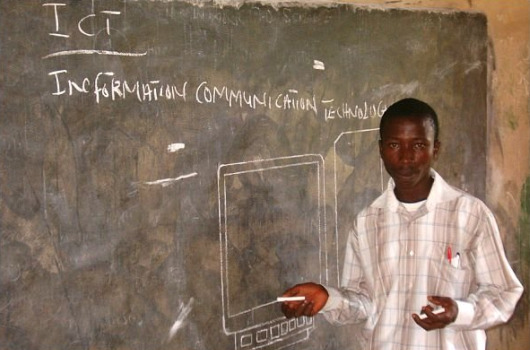
I was visiting a rural village in Ghana and had the opportunity to visit the local school. This school had hundreds of children with very few teachers or resources and it was a privilege for myself and the other volunteers to be invited in to their world, if only for a short time. We went from class to class, meeting the students, seeing their smiles as they looked at these crazy foreign folks and hearing about the lessons they were learning. The last class we entered was a government mandated computer class.

Umm… Did I mention the village had no electricity? It’s really hard to teach kids computers skills when you have no electricity in your classrooms. This teacher, like teachers around the world, worked with what he had… chalkboard and chalk.  Imagine what he could do with actual computers. Imagine if that’s how your children were being taught computers.

I feel like it’s my duty to tell his story and the story of those children trying so hard to get a basic education. I tell this story to help create awareness. If you are interested in learning more about this community and potential ways you can help, let me know.

You can also use story telling to raise funds and other needed resources, or recruit new volunteers.  Remember, good stories always share and invite you in to participate in the next chapter. No matter why you’re telling the story, at the end of the story you want people to be moved to action, asking you what  can they do to help and how soon can they start!

Free updates via RSS or Email delivered straight to your RSS reader or inbox.

{ 1 trackback }

Desiree Adaway – a blog to read « SocioLingo Africa
November 8, 2009 at 11:15 AM

{ 11 comments… read them below or add one }

1 Deb Owen November 3, 2009 at 11:10 PM

My old photography website had a whole thing I wrote about how no matter what medium we use (music, photography, video, the written word, the spoken word)….it’s all about telling the story.

But I’m with you. I like data.
For me, that means I sometimes come across too ‘matter of fact’.
So I love this post and the reminder….and the story. (And the work you do.)

Thank you!
All the best!
deb

Reply

2 Ronna Detrick November 4, 2009 at 12:10 AM

Story is everything, in my opinion, Desiree.

One of my favorite quotes: “To be a person is to have a story to tell.” (Isak Dinesen)

Keep telling yours and those of others. It’s powerful.

Reply

3 Desiree Adaway November 4, 2009 at 8:09 AM

Ronna,
That is one of my favorite quotes as well! The flip side of “telling stories” is actually hearing them and then acting on the stories we hear.
I have lots of stories of service that I am hoping to share in this space.

Thanks for reading!

Reply

4 Erin November 4, 2009 at 1:00 AM

Desire-thanks for sharing such a motivating story…I can’t agree more that stories can really attract much needed attention and I think its wonderful you are providing a venue to share such stories…look forward to reading more of your postings…

Reply

5 Desiree Adaway November 4, 2009 at 8:17 AM

Hi Erin,
I hope to use this medium to tell stories of the people who serve and the communities they serve in partnership with. People are doing exciting innovating things, and I am blessed to be a part of it!

Thanks for your well wishes!

Reply

6 Iyabo Asani, The Inner Genius Coach November 4, 2009 at 11:17 AM

Desiree, congratulations on your blog! I love it.

I believe people like you are a bridge. Take a step back from yourself and look at who you are and what you do. You have a foot in two worlds and it is your calling to bridge them. You understand data and the technical side of things. Yet your heart is in places like that classroom in Ghana with no electricity.

It is people like you that get to tell the stories of those computer-training-with-no-electricity-classrooms to the Western world that needs a broader understanding. You understand that throwing money at a problem is an insufficient treatment of the problem. It is a great beginning point but it is not the whole story.

There is a great young Nigerian author who spoke at Ted Talks about the mistake of one story. Check her out here: http://www.ted.com/talks/chimamanda_adichie_the_danger_of_a_single_story.html

The data you speak of is part of the story.

I know you can relate. I want to hear your stories!

Hugs to you!

Reply

7 Desiree Adaway November 4, 2009 at 11:25 AM

Iyabo!

The TED talk you reference is one of my all time favorites. We can never just tell one story and no story we tell is the whole truth. Stories are layered and rich. Thanks for your kind words and wonderful insight. Look for future blogs that speak to the issues of volunteers as donors, they are crucial sides to the same coin.

I hope you continue to build community with me my friend!

Reply

8 Hiro Boga November 6, 2009 at 12:34 AM

Desiree, the great thing about stories is that they are ongoing and constantly unfolding–they aren’t finished. The story you tell of the children trying to learn about computers in a classroom without electricity can become a different story when it moves people to act, to contribute to the story, to become participants who changes the story.

Please tell us more. And suggest ways in which we can help.

Reply

9 Desiree Adaway November 7, 2009 at 1:11 PM

Hiro,
Great feedback!

I will be writing a blog sometime soon about ways that we all can contribute to stories to help, support and uplift and transform. We need to start with the three C’s-communicate, connect and collaborate. These are keys that help move us from the sideline to action.

Stay tuned for my

Thanks for giving

post coming soon– I am hoping it will energize people to serve as a way to show gratitude.

Reply

10 Sociolingo November 8, 2009 at 10:54 AM

Hi Desiree, great to see your blog. Stories are so important. I look forward to hearing more.

Reply

11 Desiree Adaway November 8, 2009 at 11:19 AM

I will be using this space to tell stories that will move people to action. I welcome your feedback and hope we can work together to build awareness to communities that need our support.

Reply

Leave a Comment

Previous post:

Next post: